



* There are various theories on lace history; please note that the content presented here is
one of several theories. Please understand this in advance.
  |

|
|
||
|
HOME > About Lace > History of Lace
There are currently three theories on the origin of lace.
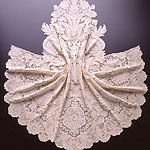
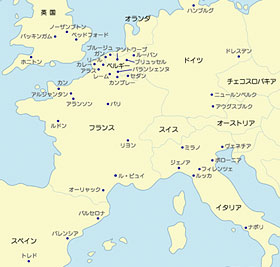
The origins of lace trace back to prehistoric hunting eras, but from the late 14th to early 16th century white-on-white embroidery developed in various forms, and by the early 16th century more open versions were sought beyond lace embroidered on linen grounds. Independent lace forms for decorative purposes such as we see today are said to have emerged around 1540. Thereafter, these laces developed in Flanders (Belgium), Venice (Italy), Alençon, Chantilly, and elsewhere in France. In the medieval craft era, lace production required much time, labor, and skilled technique; lace symbolized noble luxury, and there were even periods when commoners were forbidden to use it. Lace can truly be called the “king of textiles.” |
||||

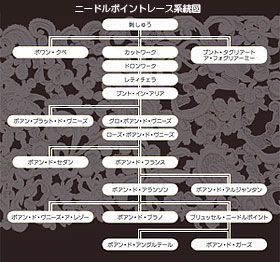
 Enlarged Genealogy Chart Enlarged Genealogy Chart |
In France, when Catherine de’ Medici came from Florence (Italy) in the early 16th century to marry Henry II, enthusiasm for lace grew; by the mid-17th century, as part of Louis XIV’s minister Jean-Baptiste Colbert’s mercantilist policy, state manufactories produced lace in the spirit of “French lace”—Point de France(Point de France: Fr.) was made.
However, the French Revolution at the end of the 18th century (1789) nearly ended production of this country’s exquisitely elaborate needlepoint lace.

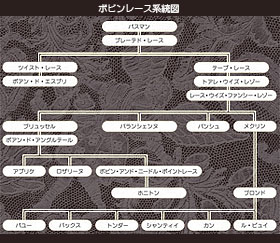 Enlarged Genealogy Chart
 |
Bobbin lace appearing in Venice and Belgium in the early 16th century seems to have been made mainly in Genoa and Milan (Italy) from the mid-16th century onward, imitating geometric needlepoint lace.
It then spread to Belgium and developed remarkably, producing its own style in the 17th century.
In the 18th century, patterns evolved into complex, exquisite designs with flowers, buds, and dots scattered across the ground; because this form was actively made in Brussels (Belgium),Brussels Lacecame to be called Brussels Lace.

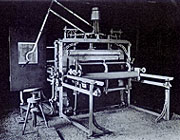 Lace machine circa 1830
 Current Lace Machine |
After the French Revolution at the end of the 18th century, the British court
Lace imports became difficult and dealt a severe blow, but
which in turn prompted the invention of machine lace.
In 1808 Heathcoat invented a machine to make bobbin net, and in 1813 John Leavers developed today’s Leavers lace machine
A prototype was made.
In Japan too, lace machines began to be imported in the 1920s,
Before World War II, in Hamamatsu, Echigo, Yokohama, and elsewhere,
was being made, but after the war it came to be made in various regions
came to be.
Today’s lace machines have undergone many improvements,
Large quantities of lace can be made inexpensively in a short time
has become possible.




