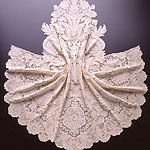
Lace is broadly divided into two types: “machine lace” and “handmade lace.”


Embroidery lace machines apply openwork embroidery patterns to fabric, tulle, and similar materials. This lace includes types where the ground fabric remains, types with cut-out holes, and types where the backing is dissolved leaving only embroidery thread—the most widely used category of lace.
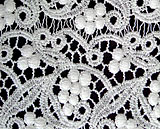
 Chemical Lace (Chemical Lace) Chemical Lace (Chemical Lace)
Net Lace (Net Lace)
Cotton Lace
|
 |
 |

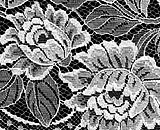
Lace made on Leavers machines. Extremely fine threads are twisted together in various patterns, giving a delicate, graceful appearance. Because many fine threads create complex structures and machine speed is slow, it is an expensive lace.
Named after John Leavers of England, who developed it in the early 19th century.
|
 |
|

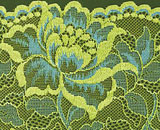
Lace made on Raschel warp-knit machines.
Patterns are formed while knitting; it finishes thin and flat.
Because it is knitted faster than Leavers lace,
Relatively inexpensive.
Jacquardtronic
Texttronic
|
 |
|

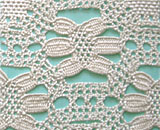
A mechanized version of bobbin lace worn by medieval European nobility on collars and sleeve trim. Often woven with thick linen or cotton thread, it has a coarse mesh. Lace width is characteristically narrow, limited to about 20 cm. Patterns are formed by a Jacquard mechanism as threads wound from bobbins are crossed.
|
 |
|