  |

|
|
||||||||||
|
HOME > LECIEN Lace Museum > Needlepoint Lace
|
||||||||||||




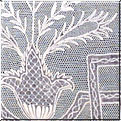 Clergy vestment hem trim
|

Drawn work removes warp and weft threads from woven fabric, and the remaining
remaining threads are bunched several at a time and stitched while patterning.
Excellent drawn work was transmitted early to Germany and Denmark,
Persian-style and floral motifs are expressed.

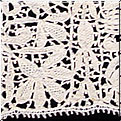 Border
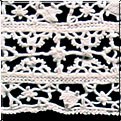 Edging Trim
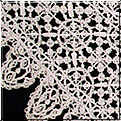 Shawl
|

Early needlepoint lace made in large quantities in the mid-1500s.
Using cutwork and drawn work embroidery on a square base,
with geometric patterns of circles, rosettes, stars, diagonal crosses, and the like,
Lace made of thread alone.
A predecessor of Punto in Aria.
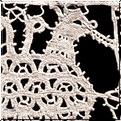 Border
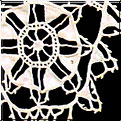 Border
|

Early needlepoint lace made in the 17th century.
Meaning “lace stitched in the air,” this lace uses no ground fabric,
Composed of thread and needle alone, also called hollow lace.
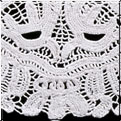 Border (hem trim)
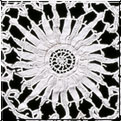 Border
|

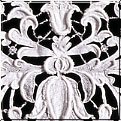 Women’s shoulder cape collar
|

A type of Venetian lace.
Lace with large motifs raised like relief carving.
Made in Italy in the 15th century, brought to France in the era of Louis XIV
techniques were transmitted, and it was most actively made in the 17th century.
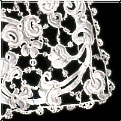 Men’s Apron
|

In contrast to large-design Gros Point de Venise, this lace uses delicate, small-scale motifs of flowers, scrolls, and leaves to create a softer atmosphere and refined design.
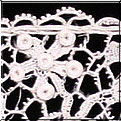 Border
 Bodice and robe front trim
|

This name arose from the establishment and promotion of the lace industry under Louis XIV’s minister Colbert’s mercantilist policy.
Technicians were brought from Italy and Flanders; workshops and warehouses were established in Alençon, Sedan, Reims, Alençon, Argentan, Arras, and elsewhere; imports of foreign lace were banned to nurture France’s domestic lace industry.
Beginning as imitations of lace leaders Italy and Flanders, by the late 1670s when technical and regional styles surpassed them, the comprehensive name Point de France was lost and names such as Point de Sedan, Point d’Alençon, and Point d’Argentan appeared instead.
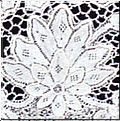 Border |

Lace made in Sedan in northeastern France.
This lace features bold patterns and picots (ring- or knob-shaped edging)
characterized by a ground of hexagonal brides.
 Border
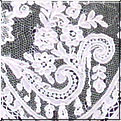 Border
|

A lace factory was established in Alençon in northeastern France in 1655; by 1678 the form of Alençon lace was established, and from this period it came to be called by the name Alençon.
Delicate, sturdy lace characterized by cord outlining patterns on thin net ground, with densely packed stitched motifs.
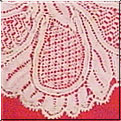 Border |

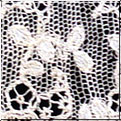
Réseau means “mesh” in French. Seeking “lighter, more beautiful lace,” French makers adopted Italian needlepoint lace and developed it to meet 18th-century fashion.
Because this lace was more beautiful made with bobbins, needle production gradually fell out of use.
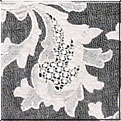 Stole
 Border
|

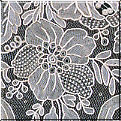
18th-century net-ground lace made on Burano Island near Venice.
The finest quality lace thread was used.
This lace ground is not made of brides or bars (branches), but
Characterized by being made with mesh or mesh stitching.
 Border (collar trim) |

A type of Brussels lace referring mainly to lace made in Flanders in the 19th century. Appeared around 1830 and reached technical maturity in the 1860s.
The name derives from thin, fine mesh like gauze. The mesh is rounded; rose and plant motifs are made as small outlined motifs one at a time and several are joined with clever stitches.




