|

|
|
|
HOME > LECIEN and Lace > History of LECIEN Lace
|
||




|
In 1933, founder Naozo Nomura started a trading company in Kyoto importing and selling textiles and daily goods; importing Swiss and French lace was the company’s first encounter with lace. Because tariffs were high at the time, lace was imported in wide widths and processed domestically into narrow widths for sale. Toward the late 1930s, war made lace imports difficult, and domestic production began through manufacturers with machinery for narrow-width and kimono lace. Initially, silk lace, velvet, and similar products were produced smoothly, but in 1940 the “July 7 Decree” (regulations restricting the manufacture and sale of luxury goods such as silk textiles) was enforced. Although this dealt a severe temporary blow to the company, sales actually grew through alternative products made from rayon purchased inexpensively at thread-producing regions. From around 1950 after the war, the company began full-scale lace manufacturing and sales, handling lace in spring and summer and woolen textiles in autumn and winter. Two-tone dyed lace, conceived by an employee who grew up in a kimono shop, traded at several times the price of single-dye products and established the foundation of the company’s lace business. The company was also the first in Japan to produce all-over garment embroidery lace. |
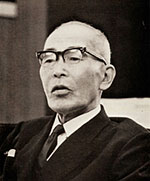
Naozo NomuraNaozo Nomura
Born in Mineyama, Nakagori, Kyoto Prefecture in 1905; graduated from the Research Department of the Kyoto Prefectural Industrial Testing Station; joined the Japan-Germany Trading Company and others; later founded the import firm Tanaka Brothers Trading; established Nomura Shoten in 1933; became chairman in 1972; passed away at age 70 in 1975.
|




